Sunday, January 19, 2014

Gem Love: TOURMALINE! Rubellite, Indicolite...and Fakes

Tourmaline is a semi-precious gemstone that comes in a WIDE variety of colors, from colorless to black, pinks and reds, yellows, blues and greens.  Certain colors have been given specific names:

  • Schorl - Bluish, brownish black to black 
  • Dravite - Dark yellow to brownish blac
  • Elbaite species: named after the island of Elba, Italy include:
    Red or pinkish-red—Rubellite variety
    Light blue to bluish green—Indicolite variety (from Brazil)
    Green—Verdelite or "Brazilian Emerald" variety
    Colorless—Achroite variety 

Rubellite and Pink Tourmaline
Indicolite
 Over 95% of all the Tourmaline in the world is Schorl.  Tourmaline's wide variety of colors is due to the chemical makeup of the stone.  Usually, iron-rich tourmalines are black to bluish-black to deep brown, while magnesium-rich varieties are brown to yellow, and lithium-rich tourmalines are almost any color: blue, green, red, yellow, pink, etc. Rarely, it is colorless. Bi-colored and multicolored crystals are common, reflecting variations of fluid chemistry during crystallization. Crystals may be green at one end and pink at the other, or green on the outside and pink inside; this type is called Watermelon Tourmaline. Some forms of tourmaline are Dichroic, in that they change color when viewed from different directions.
Watermelon Tourmaline

Some tourmaline gems, especially pink to red colored stones, are altered by heat treatment to improve their color. Irradiation is almost impossible to detect in tourmalines.  Heat treatment is also used to enhance tourmaline. Heavily-included tourmalines, such as Rubellite and Brazilian Paraiba, are sometimes clarity-enhanced. A clarity-enhanced tourmaline (especially Paraiba) is worth much less than a non-treated gem.


Chrome Tourmaline
Another highly valuable variety is chrome tourmaline, a rare type of dravite tourmaline from Tanzania. Chrome tourmaline is a rich green color due to the presence of chromium atoms in the crystal; chromium also produces the green color of emeralds.


Paraiba Blue Tourmaline - Rivals Fine Sapphire
Paraiba Tourmalines
Green Paraiba, NOT Emerald
Tourmalines mined in the Paraiba mines in Brazil are known for their beautiful colors.  They can range from neon blue, aqua, green, purple, to pale "Brazilian Emeralds" which are a very light green color.  I've (sadly) seen a number of these pale or neon-pale green stones on ebay AND etsy, sold as "Muzo emeralds" when in fact they are tourmaline (or perhaps glass).   On etsy, with one seller in particular, it's a giveaway when they offer a "Muzo emerald" ring in a huge carat weight for under $150. 


Glass "Rubellite Quartz"
Lastly, I want to mention that I've seen a LOT of jewelry on Etsy offered with lovely red stones, which are called "Rubellite Quartz".  There is NO SUCH GEM as "Rubellite Quartz".  Most likely, rather than even being dyed quartz, it is "hydroquartz" which is another name for a manmade GLASS stone.  So if you see anything listed as "Rubellite Quartz" (or "Emerald Quartz", "Tanzanite Quartz", "London Blue Quartz", basically any gemstone plus "quartz"), it is NOT a gemstone at all.  If you love the look of the vivid stone, that's great, but if you're thinking you're buying a gemstone (and they can be expensive), you are being misled.  BUYER BEWARE!

Saturday, January 18, 2014

Brazilian "Rubies" and "Sapphires" - What Are They Really??

I love hearing from people, whether they're customers on Etsy or people who read this blog.  Recently, a lovely reader sent me an email regarding so-called "Brazilian Rubies" and "Brazilian Sapphires".  I had never known about this until now----so a BIG thank you to Lesli! 

What is a Brazilian Ruby?

Colors of Fancy Sapphires (plus Clear, Black and Grey)
First of all, a ruby is actually a red sapphire!  Sapphires come in all colors, and when they're red, they're called rubies.  When they're blue, they are simply called Sapphires.  And all the other colors are referred to as "fancy sapphires" and range from clear to all shades of pink to greens, yellows, purples, even grey and black.  They are the mineral corundum, and are very hard (with a Mohs hardness of 9----almost a diamond, which is a 10).  Sapphires are mined throughout the world including Montana! 

There are a LOT of "Brazilian" rubies----strands of beads or loose faceted briolettes----for sale lately at really great prices.  These stones are quite opaque but are rich red colors, or red-to-pink colors.  They seem to be very large stones, and so affordable!  I know there are a lot of "enhanced" rubies, filled rubies (fissures are filled with leaded glass), ruby doublets, and other treatments of lower-quality corundum gemstones to make them more desirable.  Like Lesli said in her email, I assumed they were just poor quality rubies that were dyed, which would explain their cheap price.

But what are these Brazilian rubies? 
Brazilian Rubies $9/Strand


 It turns out that they are NOT rubies at all.  Not corundum stones.  These stones ARE gemstones (not glass or CZ) but actually are a light rose-pink spinel, topaz, or pink tourmaline!  According to the Encyclopedia Britanica, a very rare red colored Topaz is referred to as "Brazilian Ruby".  And per many other gem websites (such as THIS one), Brazilian Ruby is actually Pink Topaz.   The faceted rondelles (pictured right) look almost like dyed jade, and as they are sold as "Brazilian Rubies" from DHGate in China, they are most definitely NOT rubies.


So if you are searching for a real Ruby gemstone, I would suggest steering clear of any so-called "Brazilian" rubies! 

What About Brazilian "Sapphires"?

Paraiba Tourmalines
Once again, these so-called Brazilian Sapphires are NOT sapphires at all.  Per The Natural Sapphire Company's website (HERE), these are actually Blue Topaz or Tourmaline.  Apparently "Blue Sapphire" is the commercial name for Indicolite from Brazil---Indicolite is blue tourmaline.  Per the GIA, there are examples of fabulous natural violet-blue Paraiba tourmalines that rival the most expensive sapphires in look as well as price! 

I'm happy to say that I couldn't find any strands of  so-called "Brazilian Sapphires" for sale on etsy.


Blue Topaz, Indicolite (Blue Tourmaline), Pink or Red Topaz, Spinel---all of these are gorgeous gemstones.  It's my opinion that by calling another gem "Brazilian Ruby" or "Brazilian Sapphire" it crosses the line from just "creative marketing" to intending to defraud buyers.  If you want a ruby or a strand of faceted ruby or sapphire rondelles, please be aware that "Brazilian" stones aren't really corundum.

As always, buyer beware!

Wednesday, January 8, 2014

Blue Goldstone: It's NOT Aventurine or a Gemstone....It's GLASS

Blue Goldstone

There is a "stone" that is used in jewelry that is ALL over Etsy right now.  It's beautiful!  A rich cobalt blue with sparkling flecks of silver and gold and it looks like a GALAXY of stars in the night sky!  I love it and offer it in my shop as well.  But what is it?  Is it a gemstone?
Blue Goldstone Briolette on Cord

NO!  It's definitely NOT a gemstone, NOT a mineral, NOT semi-precious, and certainly *NOT* Aventurine, which I've seen it described as on Etsy!  And NOW I've seen this being sold online as "Blue Sandstone" where the seller describes this as: "composed of quartz or feldspar because these are the most common minerals in the Earth's crust. The sand inside creates the blue color. For this reason, this substance is named "Blue sandstone."  YIKES!  This is like a random string of words---none of it makes sense!  (Blue sand??)  No, this is not "sandstone".

It's not a stone at all.  It is GLASS.  Yes, Glass.  It's a manmade glass that is actually far more than just sparkles tossed into molten glass.  It begins with molten glass (silica), and copper oxides and other oxides are melted together. The vat is then sealed off from the air (a vacuum chamber) and kept at a certain temperature, so the glass remains liquid while allowing copper crystals to form without the crystals melting or oxidizing!  When cooled, the glass will have bright metal crystals suspended in semi-transparent glass.

If you google "how is goldstone made" you can read exactly how the glass manufacturers make this beautiful, glittery glass "stone".

It's truly fascinating to look at, whether it's gold (goldstone), blue (stellaria or blue goldstone), green or even purple! 

Sunday, December 15, 2013

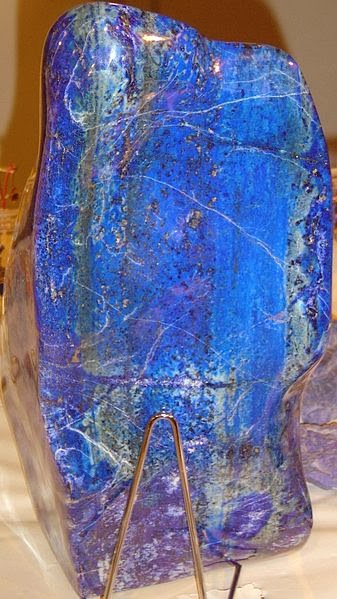
Gemstone Love: LAPIS LAZULI

Polished Lapis Lazuli Block
King Tut's Mask
Lapis Lazuli, also known as just "Lapis", is a semi precious stone that has been prized for its beautiful deep blue color since antiquity.  It has beautiful flecks of gold pyrite within the blue stone.  It is a stone, not a mineral and not a crystal.  It has been mined in Afghanistan since 7,000 b.c. and was used as the eyebrows in King Tut's mask.  In ancient times, Lapis along with Turquoise were considered the most valuable stones.

At the end of the Middle Ages, Lapis was exported to Europe where it was ground and used as "ultramarine" -- the finest and most expensive blue pigment.  It was used by the most important artists of the Baroque and Renaissance periods. Vermeer's Girl With a Pearl Earring uses Ultramarine for her head scarf.
Vermeer's Girl with a Pearl Earring

Today, most Lapis is still mined in Afghanistan, but is also found in Chile, Canada, the United States and Russia.

The name "Lapis" comes from the Latin word for stone, and from the Arabic word for blue, "Azul".   It literally means "blue rock" and it is a rock, not a mineral.  It is composed of a variable mixture of the minerals lazurite, pyrite and calcite. The finest Lapis Lazuli is uniformly deep blue in color, opaque to semi-translucent and consists almost totally of lazurite.

I see pendants made of Lapis that have been carved into "points" or even "double terminated" points, like naturally occurring crystals, on etsy and elsewhere.  This is weird because Lapis is NOT a crystal at all, and is merely made of stone (rock!) and is carved in this shape for some reason.  Very odd.

Thursday, December 5, 2013

Something Beautiful: ROSE GOLD

3 Colors of Gold
Rose Gold is sometimes called Pink Gold, or even Red Gold.  It has all the value and properties of yellow gold, but because it has a higher content of copper, Rose Gold has a beautiful, soft pink color that goes well with most skin tones.  In fact, there are ranges of color within Rose Gold.   I LOVE Rose Gold because it's a little more unique than the typical yellow or white gold, and it seems to tone down the bright "flash" of stones, giving it a more elegant or vintage look.  As it was popular in Russia at the beginning of the nineteenth century, it is also known as Russian gold, but this term is now basically obsolete.


But What Makes It Pink?

Pure 24k gold is yellow, and is very soft.  It is alloyed with other elements to produce colors and other karats.  The most common karat grades of gold, in addition to pure 24K (100% gold), are 22K (92% gold), 18K (75% gold), 14K (58% gold), 10k (41% gold) and 9K (38% gold).  For example, alloys which are mixed 14 parts gold to 10 parts alloy create 14K gold, 18 parts gold to 6 parts alloy creates 18k, etc.

There are hundreds of possible alloys and mixtures, but in general alloying gold with silver will color gold white, and the addition of copper will color it red (or pink). A mix of around 50/50 copper and silver gives the range of yellow gold alloys the public is accustomed to seeing in the marketplace. A small amount (0.2%) of zinc is sometimes added to give the gold added strength and hardness.

There are three general classifications of colored golds:
  • the Au-Ag-Cu system, producing white, yellow, green and red golds;
  • the "intermetallic" compounds, producing blue and purple golds, as well as other colors. These are typically brittle.
  • the surface oxide layers, such as black gold; the colored surface is prone to wear off.

Although the names are often used interchangeably, the difference between red, rose, and pink gold is the copper content – the higher the copper content, the stronger the red coloration. A common alloy for rose gold is 75% gold and 25% copper by mass (18k). But it's also common for 18 karat rose gold to typically add about 4% silver to 75% gold and 21% copper to give a rose color. Since rose gold is an alloy, there is no such thing as "pure rose gold".   The highest karat version of rose gold is also known as "crown gold", which is 22 karat.  14 karat red gold is often found in the Middle East  and contains 41.67% copper.

During ancient times, due to impurities in the smelting process, gold frequently turned a reddish color. This is why many Greco-Roman texts, and even many texts from the Middle Ages, describe gold as "red"!


<------Check it out!  Gold & Co. in the UK has created the world's first 24k GOLD and ROSE GOLD iPhone5 (two separate models). Expensive, and only available in Dubai.  AND, they're not solid gold---just gold plated.  I have no idea the price.


Friday, November 22, 2013

Cleaning Tarnish From Sterling Silver Jewelry: Experiment

We all have sterling silver pieces of jewelry that are sitting in a jewelry box or drawer, and look less than sparkling and bright!  Tarnish happens to ALL sterling silver, especially when left exposed to the air (as opposed to sealed in an airtight bag).

I always love to use a polishing cloth that is specifically for sterling jewelry---it's a soft flannel cloth that has been treated with a gentle cleaner that removes tarnish like magic!  There are liquid jars of cleaner, but those are some sort of acid and can ruin pearls or certain "soft" gems and are very harsh, so I don't recommend those.

But what about using products at home?  How about something cheap and natural?  I've read about using hot water, baking soda, salt and aluminum foil to remove tarnish for YEARS.  Does it really work?  I tried it today, and here's what happened:

(1)  I lined a foil pan with another sheet of aluminum foil.  The silver pieces have to touch the foil for this to work, I read.

(2) I gathered some baking soda and plain salt, and heated up some water until it was steaming.


(3) I chose a couple of tarnished Sterling Silver items from my jewelry box.  I found a box chain, a sterling heart, and a really intricate pendant that is sterling with a lot of granulation, plus rice pearls and a blue topaz gemstone in the center.


(4)  I put the pieces in the tray so they touched the foil, added about 2 tablespoons each of baking soda and salt, added steaming water until the jewelry was submerged, and waited about 5 minutes.

(5) After 5 minutes, I turned the jewelry over so both sides would touch the foil, and added a little more hot water.  And I waited another 4 minutes.

(6) I took the jewelry out of the pan and used a microfiber cloth (a VERY green one!) and rubbed the pieces.

The heart looked beautiful!  And the chain was completely tarnish-free and really sparkled!

SO FAR SO GOOD...


...except for the intricate pendant!  The tarnish was not gone on either side, and was a really weird grey color.  I repeated this whole process with just the pendant, but it still came out tarnished and dull.  It almost looked worse than when I started.  Perhaps the granulation and pearls kept the pendant from touching the foil, and that was the problem?


(7) So I got my Sterling polishing cloth and rubbed the pendant, and it immediately looked brighter and better!

After spending about 15 minutes polishing the pendant (which seemed to take FOREVER), it now looks a lot better!  It has a matte finish, and I'm not sure if that had anything to do with the baking soda/water/foil experiment fail.


SO----I would say that using baking soda and salt, foil and steaming water, really DOES work for chains and shiny silver jewelry!  It only took a couple of minutes, and the results were very impressive---especially on the chain, which has a lot of little tiny links that could never be polished by hand!  The matte silver intricate pendant didn't work, though---but polished up nicely with a sterling cloth! 

Monday, October 21, 2013

Real Quartz v. Synthetics v. Simulated v. Hydro Quartz -- Which Is It?

I live in New Mexico, in the city of Albuquerque.  New Mexico's history includes silver mines, gold mines, copper mines, turquoise mines, and lots of artisans who make jewelry out of genuine metals and gemstones.

There is a very large facility that sells jewelry supplies to jewelers ALL over the world, including being perhaps the most trusted facility to purchase silver "shot" or grains for making pure silver or sterling silver rings, etc.  They sell sterling and gold and gold-filled wire, findings, genuine gemstones, just everything a jeweler could ever want.  It's called Rio Grande Jewelry  and luckily they are located a short drive from my home, ten or so minutes away.  I go there ALL the time because they employ dozens of knowledgeable jewelers and silversmiths (I don't know how many!) so if I have a questions about a gemstone, they can answer it.  Or they can repair or re-size anything, although they're a little pricey.  They have a small showroom and I love to go look at the charms and gems they have in the cases.  And they have a HUGE warehouse so anything in their catalogs can be purchased right then and there.  Seriously, there are hundreds of employees' cars in the lot.  They also offer jewelry making classes and people come to ABQ from all over to learn from the experts.  You can call them or send an email, and they are always fast to respond, but it's easier for me to just go there with an order or questions---everyone there is very nice and really helpful.

So I rely on their expertise often, and I trust what they have to say.

I was there recently to buy some gold-filled wire and to ask them about some sterling "tree" charms they have (right in their display case) that I read about in etsy's forums (someone outside of etsy who sells charms claimed she holds the copyright to this design and made the etsy seller remove her "copies"----and yet Rio Grande has the same items.  They checked and, NO, they laughed and said they have no knowledge of any such "copyright" for the item that's manufactured in Thailand, although that seller may have the copyright on the IMAGE in her catalogue, so there's that.).

But I really wanted to ask their expert opinion on so-called "Hydro Quartz" that is found in India, Thailand and China on Alibaba, and all over Etsy, sold as though it's a gemstone.  I asked them, "Is there such a thing AT ALL as "hydrothermal quartz" or "hydro quartz" that looks like emeralds, or like blue topaz or other gemstones?"

Answer directly from Rio Grande:  "NO.  Those aren't gemstones and are most likely glass.  We don't sell that here."

So if you clicked on the Rio Grande link at the beginning of this post, it would take you to their "green quartz" listings.  It will show you what "green quartz" actually is----and not an "emerald hydro quartz" to be found.  Green Quartz is also known as Prasiolite or "green Amethyst".  If you search Rio Grande for "blue quartz", you will find gemstone "doublets" and "triplets" made with clear quartz, some blue druzy stones in blue.  They have Chalcedony (the only real blue quartz, but also can be green or white or other dyed colors) listed separately. 

So---what is a Synthetic stone? Is it a gemstone?

In the jewelry industry, a "Synthetic" stone is a man-made gemstone, made in a lab, and is considered a real gemstone, with the same physical, chemical and optical properties as the natural gemstone.   To most people, "synthetic" means "fake" but not in the jewelry industry (confusing)!  Mostly people use the term "lab created" to describe synthetic gems.  The only real way to tell a synthetic gemstone from a "mined" stone is that the synthetic (or lab-created) stone is flawless, and natural stones are generally not.  Otherwise, there is NO difference.  Jewelers will test the stones and will see it's a sapphire, for instance, but when they look at it under a loup, it's flawless and therefore PROBABLY synthetic.  Sapphires and rubies are popular synthetics, as well as emeralds.  There ARE synthetic diamonds, but they are just as expensive as mined diamonds, but they are conflict-free. Man-made, or synthetic, diamonds are $1,000 and UP per carat.  They are definitely diamonds with a Mohs hardness of 10---only diamonds are that hard.  Some examples of lab-created gemstones that are available include:
  • Emerald (Beryl)
  • Aquamarine (Beryl)
  • Alexandrite (Color Change Chrysoberyl)
  • Ruby (Corundum)
  • Sapphire (Corundum)
  • Spinel
  • Diamond - VERY expensive, costs the same as mined diamond
Please note that there are some gemstones that are NEVER lab-created:  Topaz, Peridot, Garnet, and Tanzanite are three examples that I see listed as "created" or "synthetic" all the time.  Not so!   There is no such gem as a "created blue topaz" for example---the stone would be something like glass or CZ, but definitely is not a topaz.
(Edit to add:  A friend of mine who is a gemologist said that he recently heard of a lab that was attempting to create Tanzanite as they are very scarce and difficult to mine, so synthetic tanzanite might be available in the future!  I hope so because they're beautiful!)

Then what is a Simulated stone?  Is that different?

In the jewelry industry, a "Simulated" stone is simply something that was made to look like another stone.  It doesn't possess the chemical properties of the gemstone at all.  A simulated gemstone can be glass, plastic, a crystal (like Swarovski), a rhinestone, paste, anything.  A CZ is a simulated diamond.  A Moissanite is a simulated diamond.  A green CZ can be a simulated emerald or peridot, depending on color. And so forth.

What is Hydro Quartz?  Is it Quartz grown in a lab? 

Hydro quartz seen in the jewelry industry is NOT quartz at all.  It is a "simulated" quartz, in that it LOOKS like quartz (somewhat) or other stones but does not have the chemical properties of quartz or gemstones at all.  It would test as glass.  It is NOT a synthetic quartz, or a lab-created quartz.  It is ONLY simulated quartz, or glass that is sold to look like other gemstones including quartz.  A more honest name for this "hydroquartz" is actually "Fused Quartz."

What is Fused Quartz?

Fused quartz is manufactured by "fusing" (melting) naturally occurring Quartz crystals of high purity at approximately 2000 °C, resulting in a pure, clear glass.  It is used in the semiconductor industry, optical industry and electronics and other industries, including laboratories (borosilicate glass tubes, for example).  It is also colored and sold in glass "blocks" to the jewelry industry.

Is there such a thing as Hydrothermal Quartz at all?

Yes.   Companies in the electronics industry, for example, grow pure quartz crystals.  Also, some Siberian Amethyst (a deep purple with red flash) is lab-created.