Friday, September 26, 2014

Mineral LOVE: Pyrite!


The first "rock" I ever bought was a piece of Pyrite from a museum gift shop in Chicago.  It was beautiful--sparkling and golden, almost faceted.  It was Pyrite, and I still love it!  But what is Pyrite exactly?

Pyrite Cubes
Pyrite is a mineral that is sometimes called "Iron Pyrite" because it's made of Iron and Sulfur atoms.  It's often called "Fool's Gold" because in old mining days, little pieces of Pyrite would be mistaken for gold.   Sometimes, actual gold atoms form inside Pyrite, and sometimes in gold deposits, pyrite can be found.  This is probably why it's called Fool's Gold!

The word Pyrite comes from the Greek word for "fire" because it sparks when hit against rocks or steel.

Pyrite in Fossilized Ammonite
Pyrite is found in rocks, such as limestone, shale, and coal.  It can form as crystals or in massive form (lacking any crystals).  It sometimes forms in fossils.  It has a metallic luster, but it oxidizes quickly when exposed to the air, and looks greenish or greyish due to tarnish.

Pyrite has the same chemical structure as Marcasite, although it forms different crystals and therefore is considered a different mineral.  Often, Marcasite jewelry is actually made with Pyrite.

Pyrite can be found in many forms:  in cubes, "dollars" (radiating flat
Pyrite "Dollar"
disc shapes) which are also called "pyrite suns", pyritohedral (12-sided small crystals, like a druzy), octahedral (like a double-sided pyramid).

Metaphysically, Pyrite is considered a protective mineral, and shields the wearer from negative energies while inviting prosperity and happiness!  In Fung-Shui, pyrite attracts wealth and abundance and positive energy when placed in the home or office.

There are many pyrite beads that are coated with gold or silver or other colors, including rainbow colors, that can be found on Etsy and elsewhere.  Many of these coatings are actually paint and it will scratch or even wash off.  Please be aware that these are called "coated" as opposed to plated. The honest sellers will refer to these beads as "silver colored" or "copper colored" etc.   Personally, the beautiful and natural brassy look of "raw" Pyrite is the best.

Wednesday, September 24, 2014

18k White Gold Plated Sterling Silver??? Does It Really Exist??

I keep seeing rings for sale on Etsy and Ebay that are advertised as "18k White Gold Plated Sterling Silver".

Does this really exist?

The short answer is NO.

Sterling Silver, a precious metal, is a white metal but it tarnishes fairly easily.  The jewelry industry is always searching for better alloys to mix with fine silver to create a more tarnish-resistant metal.  Regular fine silver is far less prone to tarnishing, but it's really too soft to safely hold a gemstone, so it's alloyed (mixed) with other metals.  Copper is usually used in the ratio of 92.5% fine silver to 7.5% copper.  That's why Sterling Silver is always marked ".925" to indicate the 92.5% pure fine silver (an industry standard).  Some new alloys such as Argentium Sterling Silver are on the market and are very tarnish resistant (the alloy is Germanium, which is not reactive).  

Often, sterling silver rings and other jewelry is plated with Rhodium.  Rhodium is a very hard, bright white metal, a member of the Platinum family of metals.  It is very corrosion resistant, and provides a shiny and bright finish to Sterling Silver, plus keeps the silver from scratching.  And wherever silver is scratched, it is more apt to tarnish there.

Black Rhodium plated Sterling Silver is also very popular.

Sterling Silver jewelry is a great alternative to White Gold as far as appearance.

What about Sterling Silver plated with Yellow or Rose Gold?

Sterling silver jewelry is also sometimes plated with Yellow Gold and Rose Gold in various karats---14k, 18k and even 24k pure yellow gold.  (And sometimes even "Green Gold".) When there is a heavy enough plating of yellow or rose gold, it is called "Vermeil".  Only sterling silver that is plated with at least 2.5 microns of 14k gold (or higher) can be called, by law, Vermeil.  Even Fine Silver (97% silver or more) is plated with gold to give it that solid gold look.  It CANNOT---by law---be called "Vermeil" if it doesn't reach this standard of gold thickness over sterling or fine silver.  There is ONLY Rose Gold Vermeil and Yellow Gold Vermeil (no "white gold"). 

But is Sterling or Fine Silver EVER plated with white gold?

NO.

Like Sterling Silver, even White Gold jewelry (especially rings) is almost always plated with Rhodium.  That's because "white gold" is actually yellow gold that is alloyed with white metals to give it a whiter look.  However, the resulting white gold still has a yellowish cast.  A lot of people love the "pop" that Rhodium gives the white gold, and makes diamonds appear whiter.  Even yellow gold jewelry is sometimes plated with Rhodium to give it a whole new look.  Rhodium plated white gold also helps the gold resist scratching.  Even Platinum jewelry is plated with Rhodium. 

So why are sellers claiming their sterling silver is plated with 18k White Gold?

Well, it's just what I call "creative marketing".  Others may call it "misinformation" which means "fraud".  They think that consumers feel that "white gold" over Sterling Silver is more high-end sounding, I guess.  Actually, Rhodium (like Platinum) is one of the most expensive metals.

So if you see a ring that is stamped "925" then it is Sterling Silver, and is likely plated with Rhodium.  It is NOT plated with white gold. EVER.

Is there such a thing as White Gold Plated jewelry?

Yes.  Inexpensive brass jewelry (which is not a precious metal)  is given a "flash" plating with white gold.  A lot of very inexpensive plated brass charms and chains and other jewelry items can be found all over Etsy and Ebay.  These are often made in Korea and China.

And while we're on the subject of  "plated"....

There is NO SUCH THING as "Sterling Silver Plated" jewelry!!  For example, you might see something  advertised as "Sterling Silver Plated Chain..." Sterling Silver is a term used ONLY for solid sterling silver items, and would be marked with "925".  Jewelry, like chains and so forth, can be "silver plated" which is actually plated with a very small amount of fine silver---not "sterling".   Sellers use that term so you THINK you're getting Sterling Silver, when you are not.  Or perhaps they're trying to say their item is plated with ACTUAL silver, rather than a silver-colored metal or even paint.  They would be far better off (and more honest) to call it "fine silver plated". 

Monday, August 11, 2014

About Metals: What is Brass? Bronze? Pewter? Tin?


What is Brass?

Brass = Copper + Zinc

Brass Key
Brass is a golden metal that can be polished to a mirror finish.  It has been used for many centuries and was first widely known about 500 BC.  Brass is a mixture of Copper and Zinc.  Different ratios of copper to zinc make different "colors" of brass, such as red brass (85% copper), yellow brass (65% copper), and white brass (less than 50% copper and greater than 50% zinc), and different brasses with different hardness.  Basic brass used in faucets and pipes and other objects is 67% copper and 33% zinc. An interesting fact:  copper in brass makes it "germicidal" or antimicrobial.  This means that brass actually kills microorganisms within minutes to hours of coming into contact with it!

It is used in a wide variety of things:  doorknobs, musical instruments, zippers, gears, locks, plumbing, electrical components, ammunition casings, as well as jewelry.  It has a relatively low melting point and is easy to cast.

Today, almost 90% of brass is recycled.  Since it's non-magnetic, it's easy to separate brass from other metals.

Adding aluminum to brass makes it corrosion resistant.  Tin also adds corrosion resistance and is used in seawater applications (naval brass).

Exposure of brass to ammonia will result in "stress corrosion cracking".   I can vouch for this myself---I tried adding a patina to a brass locket by exposing it to ammonia for a day, and the hinge completely dissolved!

Brass is often coated with oil to protect it from corrosion.


What is Bronze?

Bronze = Copper + Tin

Rodin's "The Thinker"
Bronze is a brownish metal, an alloy consisting of mostly copper plus tin.  Sometimes other alloys are used, such as manganese, aluminum or silicon.  Bronze was the first alloy, from around 3500 BC and gives its name to the "Bronze Age".   When left to the elements, bronze will develop a beautiful patina.   

Bronze is widely used in cast sculptures, and due to its corrosion resistance, is used in naval propellers, fittings, and bearings.


What is Pewter?

Pewter = Tin + Copper

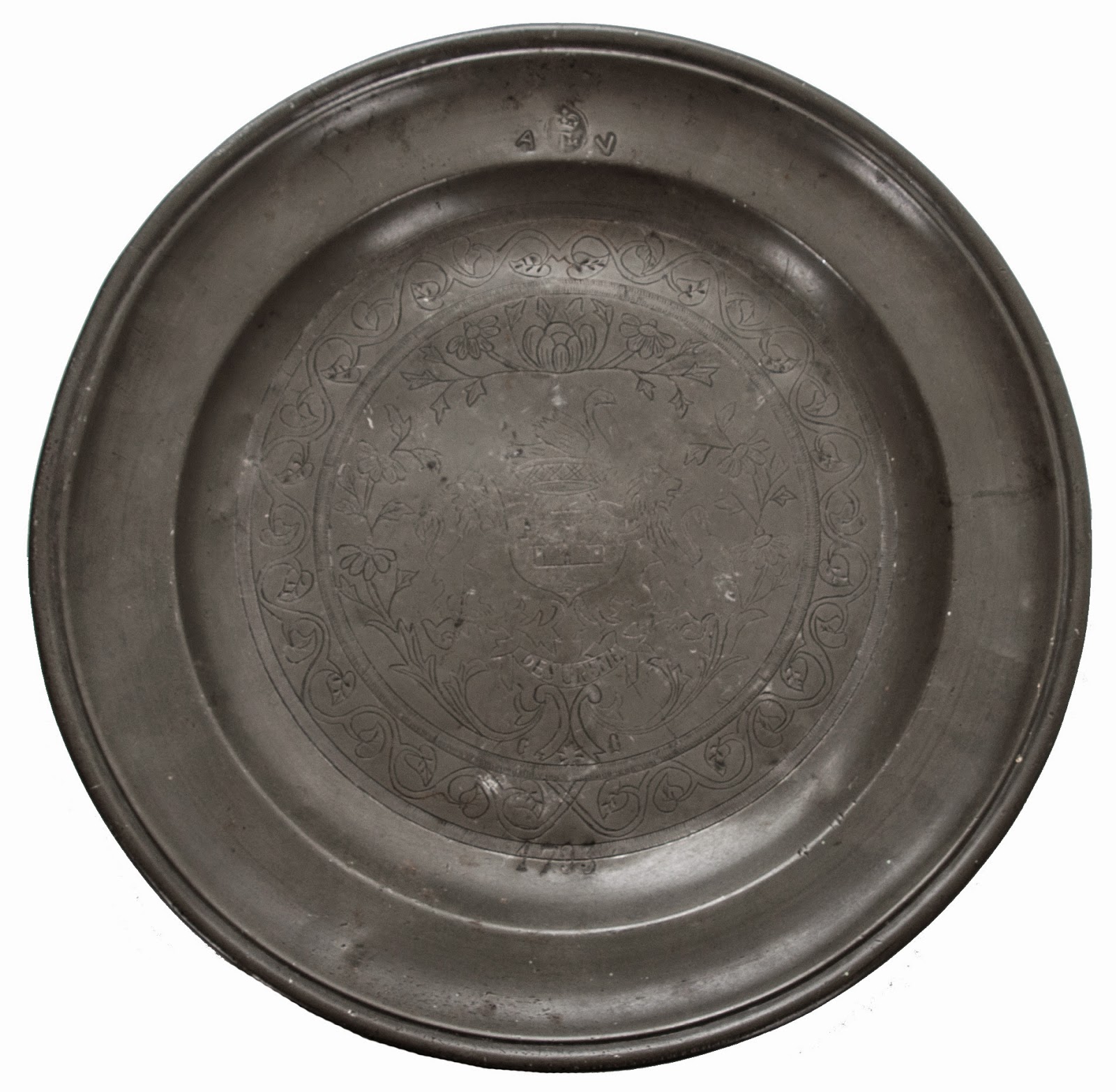
Pewter is a grey alloy of Tin plus Copper.  It is between 85-99% tin.  Pewter that has a bluish tint is Tin alloyed with Lead, although this is uncommon today.  The earliest piece of Pewter found was in an Egyptian tomb from about 1450 BC.

Pewter Plate, French, 1793
Pewter was the main component in tablewear (plates, cups, silverware) used by the Egyptians, Romans, and throughout Europe until porcelain and glass were used in the 18th Centuries, when mass production of pottery replaced Pewter.

Today, pewter is mostly used in decorative objects, pendants, and replica coins. 


Cassiterite with Tin

What is Tin?

Tin is a silvery-white metal found on the Periodic Table with the atomic number 50.  It is highly resistant to water corrosion and is used to plate other metals.  Tin is the 49th most abundant element in the Earth's crust.  Tin must be extracted from other ores, mainly Cassiterite.

Today, about 50% of all tin is used in solder, and the other half used in the production of brass and bronze, and tin plating. of objects such as steel whistles (tin whistles), and steel cans (tin cans).  It is also used in Li-ion batteries.


Saturday, July 19, 2014

ARAGONITE: Is There A Rare Faceted Gemstone Or Etsy Fraud?

I saw a ring on etsy that is VERY expensive.  It's advertised as Aragonite and is described as being a one-of-a-kind gemstone, Pleochroic (see below), and so very rare due to its "birefringence" which the seller described as meaning that the stone exhibited "different colors on different facets."  (And that is NOT what the term means....see below!)  The gem in this ring was even given a "name" --- you know, like the Hope Diamond or the Timur Ruby.  They claim this particular stone is "one of the rarest faceted gemstones on earth"!  In doing a simple Google search, no such named Aragonite appears, except the one listed on etsy.  The "name" of this gemstone is also the ancient name of the Kingdom of Aragon, which is simple history and is now known as the region of Aragon, Spain.   And this supposed rare and exquisite "gem" is mounted in a Sterling Silver setting.... well, if this were indeed an expensive gemstone ring (listed at well over $20,000!) then it most certainly would have been set in platinum, or white gold, or yellow gold.  So that's a giveaway right there that something in the milk ain't clean, so to speak!

If you Google images of Aragonite, you can see what it really looks like.

What is Aragonite?

Aragonite Crystal-Spain
Aragonite is described as "a mineral consisting of calcium carbonate, typically occurring in white seashells and as colorless prisms in deposits in hot springs."  It is formed by biological and physical processes, including precipitation from marine and freshwater environments.  The common mineral Calcite is also made of calcium carbonate.  Per www.minerals.net, "There are many Aragonite crystals sold to collectors that are in fact really calcite."
There are many Aragonite crystals sold to collectors that are in fact really Calcite pseudomorphs after Aragonite - See more at: http://www.minerals.net/mineral/aragonite.aspx#sthash.KiuX60SO.dpuf
There are many Aragonite crystals sold to collectors that are in fact really Calcite pseudomorphs after Aragonite. - See more at: http://www.minerals.net/mineral/aragonite.aspx#sthash.KiuX60SO.dpuf

It's named Aragonite after Aragon, Spain, where it was first discovered.  It is also found in the Czech Republic, Mexico, Austria, and even Carlsbad Caverns here in New Mexico, which form as stalactites.

It is often used in replicating reefs in aquariums.

Aragonite is the main component in such organic gems as pearls, coral and mother-of-pearl.  It is Aragonite that gives the nacre its iridescent look.
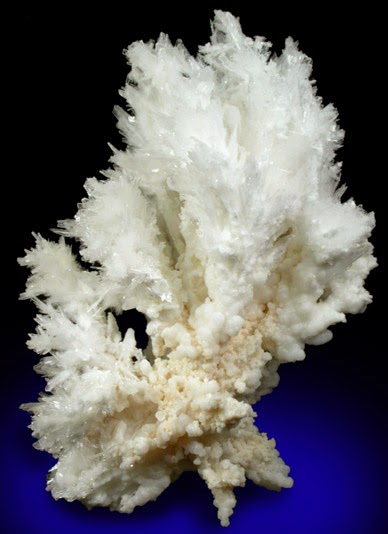
Aragonite Needle Spray - Austria

Aragonite forms in many environments, and can be banded as well as nearly colorless or brown.  It can be found as colorless, white, brown, grey, yellow, red, pink, green, blue, purple, orange. 

Colorless, white, brown, gray, yellow, red, pink, purple, orange, blue, green - See more at: http://www.minerals.net/mineral/aragonite.aspx#sthash.KiuX60SO.dpuf
It is actually Aragonite that is sold as "Mexican Onyx" or "California Onyx" or even "Onyx Marble" and "Suisan Marble".
Flos Ferri Variety
It is VERY soft and brittle, with a Mohs hardness of 3.5-4 which makes it unsuitable (as a gemstone) for jewelry.   Window glass has a Mohs hardness of 5, so this is much softer than glass.   In fact, the Flos Ferri variety of Aragonite will break when touched!   As a crystal, it has a luster that is described as "vitreous, dull" and is brittle.


What is "Birefringence?

Well, first we have to discuss refraction.  When light passes through something, such as a gemstone, or even a glass of water with a straw in it, the light rays are "refracted" or bent at an angle.  Light passes more slowly through water which is why the straw seems bent.
Birefringent Aragonite on Graph Paper

Each gemstone as its own refractive index, and this is used to identify gemstones.  Some gems are singly refractive----diamonds, spinel, and garnet, and also opals and organic gems (pearls).  Most gemstones are doubly refractive.  This means that a beam of light is split into two beams, each beam traveling at a different speed and path through the stone.  "Birefringence" is the measurement between the two beams.  Most gemstones' birefringence is hard to detect with the naked eye.  Sometimes it's very strong, and if not cut properly, can result in a blurry looking stone. 

So this particular etsy seller said their stone was "Birefringent", as if that was rare.  It's the most common!  And it has nothing whatsoever to do with varying colors....because that would be called "Fire" or "Dispersion" in the jewelry world.

What is Dispersion or Fire?

When the white light rays are refracted inside the gemstone, the rays are split into the colors of the rainbow (like a prism).  This colorful effect is called "Fire" in the jewelry industry.   Diamond has the highest Fire of all the natural (non-synthetic) gemstones.

Dispersion - Aragonite

A genuine Aragonite, which again is really too brittle to wear as jewelry (and is more of a collector's gem), exhibits certain qualities, as all individual gemstones do.  Per http://www.classicgems.net/gem_aragonite.htm,
Aragonite exhibits a Dispersion (or fire) is considered "weak".   The dispersion for a CZ is high. Pleochroism (or the ability to be different colors at different angles) is NONE.  This seller is claiming it IS pleochroic!  Not possible if it's Aragonite.  And all the fire "dancing" around the stone pictured on etsy?  Not possible if it's Aragonite. 


What About Aragonite on Etsy?

I did a quick search for "Aragonite Ring" on Etsy, and there were 59 items found.   58 of these items are definitely and truly Aragonite!  They look like rough crystals, or opaque and banded stones in the various natural colors of Aragonite (such as blue, yellow, brownish, pinkish).  And they're lovely!  But this one ring... could it be Aragonite?  Or could it be a "jonquil" CZ set with two clear CZ baguettes?  Some other stone?  The seller showcases this ring with different lighting, and the "flash" or "fire" in the stones looks like a CZ, and nowhere are pictures or descriptions of "fire" in faceted Aragonite.   So luckily I live near Rio Grande Jewelry, THE major supplier to the jewelry industry world-wide, and I asked one of the gemologists there to take a look at this listing.  Their opinion was that without testing, they couldn't be sure what it was, but it didn't look like any Aragonite they've seen.   They said the pictures show a very clear stone (not blurry, such as seen in the Aragonite pictured above) with the fire exhibited in many stones, most particularly Cubic Zirconia which is available in many colors, even color-shifting CZ stones.  I of course am not going to pay over $20,000 to purchase it in order to have the ring tested.  (Especially from a seller who will NOT accept a refund even for misrepresented stones; i.e., fakes---as their one-star feedback states!)   And the clear baguettes are obviously CZ and in NO way are "clear Aragonite".

Prices Per Carat

Per the website gemsociety.org, there are suggested retail prices per carat for gemstones.  These are RETAIL, not wholesale.  For Aragonite, it is listed as between $26 and $260 per carat for Aragonite that is 5 carats and up. 

* * * * * * * * * * * *
It's so sad to see gemstone claims like this online, as it taints the reputation of all online jewelers and Etsy sellers.  I would not suggest purchasing that ring, and for that price, you could purchase---from a reputable jeweler---a diamond or other gemstone, set in gold or platinum,  that would increase in value. 

BUYER BEWARE!!


Colorless, white, brown, gray, yellow, red, pink, purple, orange, blue, green - See more at: http://www.minerals.net/mineral/aragonite.aspx#sthash.KiuX60SO.dpuf

Thursday, June 26, 2014

What is Paraiba Tourmaline? Is there "Paraiba" Apatite, Quartz, Fluorite etc.?

For awhile now, I've been seeing a lot of jewelry on etsy (and elsewhere) that is made with "Paraiba" gemstones.  I've seen Paraiba Quartz, Paraiba Apatite, Paraiba Opal, Paraiba crystals, as well as Paraiba Tourmaline.

But what is "Paraiba"?  

In 1989, in Paraiba, Brazil, a beautiful blue Tourmaline was found.  This blue was unlike anything else---an electric blue, almost neon, sometimes called "swimming pool blue" and it seemed like it was lit from within.  It has a dazzling turquoise to green color range.   Tourmaline is a gemstone that is found in a rainbow of colors---yellows, reds, greens, black, blue---but this was special.  This beautiful turquoise blue color was due to the presence of copper and manganese.  Because of variations in the amount of copper in Paraiba Tourmaline, it can range from vivid turquoise to emerald green colors.  More manganese results in violet to red colors of tourmaline.

Paraiba Tourmaline Trillion
When this Paraiba Tourmaline was introduced to the marketplace in 1990, it was immediately in huge demand.  The demand was far greater than the supply.  Meanwhile, in Africa, around 2001, very similar Tourmaline was found that was also a vivid blue color, although just a tiny bit lighter.  It was called "Paraiba Tourmaline" even though it wasn't mined in Brazil.  This helped supply the marketplace with the demand for this blue tourmaline.  After much consideration, it was determined by the gemstone community that Tourmaline that matched the color and had  copper and manganese present could be called "Paraiba Tourmaline".

Tourmaline is a specific gemstone.  It is NOT quartz, it is NOT topaz, NOT fluorite, it is NOT Apatite, it certainly isn't Opal or glass.  Paraiba Tourmaline is extremely rare and very expensive.

Then what is Paraiba Apatite or Quartz etc.? 

"Paraiba Quartz" on Etsy--is GLASS
There is no such thing!  Because of the popularity of Paraiba Tourmaline, sellers are using the term "paraiba" to describe pretty much anything that is blue.  Apatite is blue, but it's not tourmaline.

I just did a search on Etsy for "Paraiba" and 853 results turned up.  While there are some true Paraiba Tourmalines and some "Paraiba Like Tourmalines", there are also "Paraiba Fluorite", "Paraiba Topaz", Paraiba Opal", "Paraiba Quartz", all in different colors of blues.  And that's just on page ONE!  I didn't bother to look at any other pages on Etsy.

"Paraiba Apatite" on Etsy
This is simply "creative marketing".  Sellers are using the term Paraiba to grab your attention and make you believe you're getting something of great quality.  Sorry, but only Paraiba TOURMALINE should be called Paraiba.  Honest sellers would say something like, "Paraiba color" if they must use the term at all to describe Apatite or other stones.

Tuesday, May 20, 2014

What Are "Precious Metals" In Jewelry?

Today on etsy I saw a listing for a gold plated ring.  The seller said---right at the top of the listing--that this was a "Precious Metal" ring...except it said "24k Gold Plated".  There was no mention of the underlying metal, which could have been anything but was probably brass.

Is this really a "precious metal ring" in any way?

The short answer:  NO

What Are Precious Metals?

A precious metal is a rare, naturally occurring metallic chemical element of high economic value.  Precious metals have historically been used in currency (coins) and have a high value.

Precious metals are only Gold, Silver and the Platinum group of metals (such as Palladium and Rhodium).

What Are Precious Metals In Jewelry?

Pure 24k Gold and 99.9% Fine Silver are too soft to be used in jewelry, so other metals are alloyed with the gold or silver to make them hard enough to hold gemstones, hold their shape, and resist scratching and bending.  Karat Gold (10k, 14k, 18k, 22k, 24k) is considered precious in jewelry.  Sterling Silver and Fine Silver are also considered precious metals in jewelry. Platinum, being an extremely rare and expensive metal, is the ultimate precious metal.

What About Metals Plated With 24k Gold?

When base metals, including brass, are plated with gold or rhodium, they are NOT considered "precious metals".  They are simply base metals that have been flashed with a very thin layer of gold.

Often in jewelry, a ring or other piece of jewelry will be described simply as "gold plated" or "rhodium plated".  The underlying metal could be tin, aluminum, brass, copper, nickel, zinc...or could even be plastic.  Coating something with gold, whether it's 24k gold or 14k gold plated, does not make that item "precious".

What About Gold Vermeil?

Vermeil is gold plated Sterling Silver or Fine Silver----all precious metals.  It must have a certain amount of gold (14k or higher) plated on the silver, as mandated by the FTC. So yes, Vermeil is considered "precious".

What About Gold Filled Jewelry?

Gold Filled, or "rolled gold" or "rolled gold plate", is brass or copper that has a thin layer of karat gold that's mechanically bonded or heat-fused to one or both sides of the base metal, then rolled out into sheets to create jewelry.  The thickness of the gold layer can vary, but must be 5% (or 1/20th) of the total weight.  In other words, gold filled jewelry is 95% base metal with 5% karat gold (which itself is a percentage of pure gold), which is a considerably larger amount of gold than found on other plated brass.  This means it will provide the look of gold for a longer time than other gold plated brass pieces. Still, it's not considered a precious metal, since it is 95% brass or copper.


Saturday, May 10, 2014

"London Blue Quartz" -- What is it? NOT a Gemstone!

Let me get straight to the point:  The ONLY "London Blue" gemstone is topaz.  That is IT.

I've written about Quartz gemstones before.  Specifically, I've written about the unbridled fraud and misinformation in the jewelry marketplace regarding hydroquartz, or quartz that is sold as "aquamarine quartz", "tanzanite quartz", "Swiss Blue quartz" and other supposed quartz which has familiar sounding gemstone names.

Today I noticed a LOT of so-called "London Blue Quartz" in jewelry.  Please know that there is NO SUCH GEMSTONE as a blue quartz that is crystal clear, no matter what it's called.   There are mystic coated clear quartz stones (aqua aura), but no synthetic (created) blue quartz. 

I've also noticed that most of this "quartz" is sold on Etsy, and some on Ebay.

What Forms of Quartz are Gemstones? 

Quartz is the second most abundant mineral on earth (the first being feldspar).  It's a beautiful crystal clear mineral (known as Rock Crystal or Pure Quartz) that comes in a wide variety of colors which occur due to impurities.  When it's purple, we call it Amethyst; when golden yellow, it's Citrine; milky to nearly transparent pink is called Rose Quartz; deep brown is known as Smoky Quartz; Aventurine is a green semi-translucent stone that resembles jade.  Chalcedony and Agate are forms of Quartz.  In fact, there are more variety names given to Quartz than any other mineral.  There is also Rutilated Quartz (with golden needles or rutiles within the quartz) and Tourmalinated Quartz (with tourmaline rutiles).  There is even a form of cat's eye quartz that is usually greyish with a very week "cat's eye" effect. 

As a gemstone, Quartz is often enhanced.  Prasiolite, or "green amethyst", is produced when heating certain forms of Amethyst.  Amethyst itself is often heat treated to enhance the purple color.  Almost all forms of Citrine are produced by heat-treating amethyst.  Mystic quartz is synthetically colored by irradiating gold.

What About Blue Quartz?

Blue Quartz exists, but is never clear like topaz.  It is called Blue Chalcedony, and is an opaque stone.


What is the "Blue Quartz" that is clear, on Etsy?

It is most likely glass, or fused glass, fused silica, or fused quartz.  None of these is a gemstone, in that they aren't minerals.  Just glass.

Aside from blue Chalcedony (which is a milky stone), there is a very rare form of Blue Quartz called Dumortierite.  Other than that, there is "aqua aura quartz" which is clear quartz that has been irradiated with gold.

How About Hydro Quartz?

Actual Hydro Quartz is a synthetic crystal that is made in labs for the electronics industry.  It's not produced for jewelry.

What about all the Hydro Quartz Sold as Gemstones?

That is GLASS.  The briolettes and so-called "blue quartz gemstones" that you find ALL over Etsy, etc., are nothing more than manufactured GLASS.  They are not gemstones.  They are not quartz.  They are beautiful and sparkling clear manufactured glass stones that are produced all over the world, specifically in China and India, where they are known as "Hydroquartz Glass".  Somehow the word "glass" is dropped when marketing these pieces here in the U.S.  As I wrote in my previous post about this, gemologists and independent labs have analyzed many pieces of  "hydroquartz gems" and all of it turned out to be glass.

What About London Blue Quartz?  Tanzanite Quartz?

None of these are any variety of the gemstone Quartz.  These are glass.  NOT a gemstone.

What About Emerald Quartz? Sapphire Quartz?

This is interesting.  Because the green or blue dye used to color enhance gemstones isn't stable or results in uneven or unstable colors, a different method is used to produce "Emerald Quartz" and "Sapphire Quartz".  Aside from the glass "hydro" versions of this stone, these stones are made by cutting a piece of clear Rock Quartz in half, and then gluing the pieces back together with a thin layer of dyed glue.  So the color you are seeing is actually the tinted GLUE which is sandwiched between two pieces of clear quartz.

What's a Quartz Doublet?

Just like the Emerald Quartz and Sapphire Quartz above, a clear quartz gem is cut in half and then re-assembled with tinted glue.  The result is a beautiful quartz gemstone that looks vibrant and colorful and is only revealed to be a doublet when immersed in water. 

How Do I Know What I'm Buying?

If you are purchasing from an honest seller, whether on Etsy or Ebay or online, just ask.  I purchase my stones directly from Rio Grande Jewelry Supply, which is a jewelers' supply store and VERY reputable and trusted by jewelers all over the world.  If you visit their site (riogrande.com), they describe Emerald Quartz and Sapphire Quartz more clearly and in more detail---and they divulge that it's the colored glue that gives the clear blue or clear green color of quartz.  Rio Grande sells ALL kinds of natural gemstones, synthetic (created) gemstones, and diamond simulants such as CZ and Moissanite.  They do NOT sell any "hydro quartz".  In fact, if you search Rio Grande for "blue quartz", only druzy stones and "doublets" are found.  You can view this at http://www.riogrande.com/Search/blue-quartz


An educated consumer is a good thing!  Buyer beware.  Don't think that because someone has sold a lot of jewelry on Etsy or they charge a lot for a piece of hydroquartz jewelry that it's a gemstone.  Hydroquartz is NOT a gemstone.  If you love the look of a beautiful, crystal-clear blue stone, enjoy wearing it!  But understand that it's not a true gemstone, and has no intrinsic value.   Most of all, remember this:

There is no such thing as a clear (non-milky) type of Blue Quartz!  Aside from the adhesive-tinted doublets, there is NO BLUE QUARTZ that is crystal clear, or called London Blue or Sky Blue or Aquamarine or Tanzanite or Swiss Blue.  Those are manufacturer's names of glass products.  They are taking well-known names of Topaz or Beryl or other gemstones to FOOL consumers into believing they are buying a gemstone.  IT IS NOT.