Saturday, February 22, 2014

Rhodium Plated Sterling Silver: What Is Rhodium?

A lovely etsian sent me an email today and said they were confused, because I described a bracelet as Sterling Silver but also Rhodium plated.

Rhodium plated fine jewelry (like Sterling Silver) is SO common  that I never realized that there could be any confusion. It never occurred to me!  I know I've seen Rhodium plated (and gold plated) base metal chains and hydrangea leaf charms and things all over etsy (which are given a "flash" of Rhodium or gold), but I never really thought that people might not realize that fine PRECIOUS metals are also Rhodium plated. So I thought I'd explain it here.
~~~~~~~~~~~~~~~~~~~~~~~~

Rhodium is the most expensive metal on Earth.  It is used to plate high-end jewelry made of Sterling Silver, White Gold and even Platinum.  It provides a very high, and very lustrous finish and helps prevent oxidation (tarnish) on Sterling Silver.

Some lower-end jewelry such as brass is sometimes Rhodium plated to give it the look of high-end jewelry.  Rhodium plated brass will look just like white gold or Sterling Silver, but will not be hallmarked.  Sterling is always hallmarked "925" or "Sterling" by law, and gold is hallmarked by karat (10k, 14k, 18k, etc.).

What is Rhodium?

Rhodium
Rhodium is a chemical element that is a rare, silvery-white, hard, and chemically inert transition metal and a member of the platinum group. It has the chemical symbol Rh and atomic number 45.  It has a very high melting point at 3,565°F. 

It is one of the most expensive metals, at almost twice the price of platinum and three to four times the cost of gold. Rhodium has an extremely high reflectivity and doesn't normally form an oxide, even when heated.

Because rhodium is a "noble metal" and inert, it withstands corrosion and makes Sterling Silver and White Gold more durable as well.

Additionally, rhodium is hypoallergenic. White gold and even sterling silver employ nickel to provide the whiteness of white gold, however, approximately 20% of women will have some form of allergy to nickel. Thus, by rhodium plating, a possible allergen is removed from contacting your skin. 

Why Is Sterling Silver Often Rhodium Plated? 

Pure silver (99.99% silver) is very soft and scratches easily and is too soft to hold gemstones. Other metals, mostly copper, is alloyed with pure silver to form Sterling Silver.  Sterling is hallmarked .925 indicated that it is, by law, 92.5% pure silver, and 7.5% copper (or occasionally nickel). 

Rhodium plating can dramatically increase the long term durability, brightness and luster of the finish.  Rhodium plated sterling silver will remain tarnish-free for a longer period of time than unplated sterling silver.

Why Is White Gold and Platinum JewelryAlso Rhodium Plated?

White gold is an alloyed metal--mixing yellow gold with nickel or other metals to achieve a whiter look.  However, it still has a slightly yellow cast.  To achieve the brightest finish, particularly on engagement and wedding rings, all white gold is Rhodium plated.  This also enhances the diamonds or gemstones set in the white gold, and provides a hypoallergenic finish (since a large number of people are sensitive to nickel).  Platinum jewelry ils also Rhodium plated.  That seems strange, but platinum is rough-looking and more grey, a little bit like a new nickel, and plating it with Rhodium gives it that very shiny and bright, smooth look.

Does it Wear Off?

Yes, Rhodium will eventually wear off, especially on everyday rings like a wedding or engagement ring.  However, it's easily re-plated and jewelers recommend replating jewelry every 3 or 4 years.  The cost is about $45 to replate with Rhodium, and the original luster is returned.  Keep in mind that Rhodium plating will not eliminate dents and scratches but it will  make the jewelry more shiny and bright and more expensive looking.


Wednesday, January 29, 2014

Emeralds, Rubies and Sapphires from India are FAKE: Really DYED SILLIMANITE!


Ebay Seller with FAKE gemstones--from India
I've seen a LOT of gemstones from India lately that are very cloudy and opaque, but vivid colors of green, red and blue and are sold as emeralds, rubies and sapphires.  They are remarkably affordable and are very large.  The appear to be low-quality gemstones that have been enhanced.  I've wondered what these stones are, really, because there is no way that an emerald the size of a dime or quarter or larger would be set in silver and sold for WELL under $50, and often for $10 or less.  These kinds of gems from India are sold ALL over ebay and on etsy.  One ebay seller with "gems" from India even provides "Certificates" authenticating these stone as "genuine" mined Corundum rubies and sapphires, and Beryl emeralds, always described with "parting planes" that are visible with magnification.

"Emerald" Sillimanite
Today in my etsy feed I saw a very large green emerald two-stone pendant for $17.99!  The seller described it as "Emerald (Sillimanite)" from Jaipur, India.  It's a really beautiful pendant over 2" long, with fabulously green stones, elaborately set in solid sterling silver.

After a little internet searching, I've discovered that a number of articles have been written since 2009 regarding the use of the mineral Sillimanite in jewelry, that has been dyed and sold as emeralds, rubies and sapphires.  Testing was done on these stones to reveal this fraud.  Per gemologyproject.com:


A fibrous sillimanite dyed red simulating a ruby.
"Fibrous sillimanite is very often dyed to imitate various "precious" gemstones like ruby, emerald and others. This type of sillimanite has a massive fibrous like appearance under magnification and show color concentrations...Such dyed sillimanite is now very often encountered in India."
It would seem now that the vast MAJORITY of so-called "emeralds", "rubies" and "sapphires" from India are in fact dyed Sillimanite.  The big giveaway is that these stones are highly fibrous, and opaque, as you can see in the "ruby" above.
Dyed "Sapphire" Sillimanite


Interestingly, per The Gemology Project, in Sillimanite, Chatoyancy (cat's eye effect)  is common  in Sri Lankan blue-green stones and can have six-pointed stars which can imitate star sapphires, as seen in the photo, below right.
Chatoyant sillimanite cabochons


WHAT IS SILLIMANITE?
Blue Kyanite Crystal

It is a mineral also known as "fibrolite" and is named after Benjamin Silliman (1779-1864).  It is a member of the aluminosilicate series, which also includes Andalusite and Kyanite!
Sillimanite can naturally be found in the colors Sapphire blue, blue-green, colorless, white, gray, yellowish, brownish, greenish, bluish, violet-blue.  It can be transparent to highly fibrous.
Mohs hardness of 6 to 7.5.
60x Magnification showing Sillimanite Fibers


SO...a big thank you to the honesty of Etsy seller RavishingImpressions and to their GORGEOUS and affordable jewelry.  They were honest to include the "Sillimanite" disclosure right there in their title, and I really appreciate that.  It is a beautiful dyed stone that looks like a very opaque emerald, and is very affordable. 

If you encounter gems from India that look like the pictures here, and are described as precious emeralds, rubies or sapphires, and are very affordable, be very wary.  NEVER buy any "gemstones" from ebay, particularly from seller Gems-India who fraudulently state these stones are precious gemstones AND provide phony documentation.  The marketplace is FLOODED with misleading gemstones, and downright fraudulent misrepresentations, so as always, BUYER BEWARE!!

And now we all know!

Tuesday, January 21, 2014

Quartz Doublet: What Is It? Tinted GLUE???

"Green Quartz Doublets" or "Emerald Quartz Doublets"
I get Etsy's emails, and they feature stores or items (how they're chosen is anyone's guess!).  Today's "finds" had a lovely pair of earrings that looked like emeralds (NOT the exact ones pictured above--but very close).  So of course I clicked on it!

The earrings were $400 and described as "emerald like green quartz doublets" set in plated mystery metals.  That seems really steep for earrings, especially set in plated junk metals (not sterling silver) and even though their tags were "emeralds" and "emerald earrings" they were not described as emeralds at all. 

I've seen, and sold, Opal doublets and triplets.  Triplets are slices of actual opal that are sandwiched between onyx and a cap of clear quartz.  So opal triplets are true opals plus semi precious gemstones, making them affordable AND real.  A doublet is a "cap" of clear quartz adhered to a flat "slice" of opal---two pieces, without the third bottom stone, and therefore a doublet.  These are referred to as "assembled stones".  The important thing is to disclose that they are "triplets" and I described in my etsy listing exactly what an opal triplet is.  Honesty and full disclosure.

So, what are "green quartz doublets"?  Or any "quartz doublets"?  What two stones are used to make this a doublet?

Searching the internet, I see these "quartz doublets" are sold OFTEN on home shopping networks HSN.com, and ShopHQ.com (formerly ShopNBC) and other TV shopping channels.  So they're plentiful, but not much info available on those sites about the stone.

Blue Sapphire Quartz Doublet
But THE greatest website is RioGrandeJewelry.com.  Rio Grande is THE major supplier of metals (like sterling wire or pure gold grain) and gemstones and supplies to the jewelry industry.  And luckily, they are near me here in New Mexico and I use their expertise regarding vintage jewelry I have.  RioGrandeJewelry.com is selling a "Blue Sapphire Crystal Quartz Doublet" as pictured left for about $4 for a 6mm stone and $15 for a 12mm stone (HERE), with the description of the stone as follows (emphasis mine):


"This doublet is composed of a clear quartz top and bottom;  the adhesive that holds the two together provides the beautiful sapphire color."

The fact that "sapphire" in this stone is actually BLUE GLUE would account for the cheap price tag.  And any other "green quartz doublet" would also be worth next to nothing.  RioGrandeJewelry fully discloses what their stones are----it's the only place I trust.

If you look at that same RioGrande page and scroll down to their description of "Doublet Stones" which specifically describes the "green quartz doublets", you can read this:
What Is a Doublet Gemstone?
Producing consistent green and purple colors in laboratory-grown gemstones can be extraordinarily difficult. Doublets (sometimes called soudées*) allow labs to produce consistent colors by using a tinted adhesive to attach two clear pieces of laboratory-grown spinel. The crown and the pavilion are joined with the adhesive at the girdle.

Unless the stone is immersed in highly refractive liquid (such as water), it is impossible to tell that only the girdle zone of a doublet has color.

IMPORTANT: Because laboratory-grown spinel doublets are assembled with glue, it is important not to apply heat to the gemstone. To be safe, clean these gemstones using warm, soapy water and a soft brush.
*(Note: soudées is French for "welded".)  And Rio Grande then provides photos of a quartz doublet submerged in water, which allows you to see the thin layer of colored glue and the clear quartz becomes transparent--invisible!---in the water.
 
So unlike an Opal doublet or triplet where an actual SLICE of the gem is sandwiched between gemstones, and is considered an "assembled" stone,  a so-called "quartz doublet" is TINTED GLUE beween two pieces of quartz.  (Or tinted glue between two pieces of lab-created spinel.)

Emerald Quartz Doublet on ShopHQ
On ShopHQ.com as I mentioned already, they offer "emerald quartz doublets" set in jewelry.  They SORT OF disclose what this is as follows (and I'm sure their legal department says this is the BARE minimum information they can provide):

"Emerald quartz is created using natural, clear rock crystal or natural quartz and is assembled together with the colored layer in between the upper and lower portion of the stone. This method of assembly is permanent so the color will not fade. The doublet avoids any irradiation and thin surface treatments, like diffusion, that can chip away with time. Compared to common surface treatments, it also preserves the natural crispness of the quartz since the green hue comes from within the stone, thus allowing the gemstone to appear more brilliant and alive. Emerald quartz has a Mohs rating of 7. It can be safely worn on a daily basis and cleaned with regular jewelry cleaners. 
So they disclose that there is a "colored layer" but they DO NOT say it's glue.  That to me is misleading and disingenuous, trying to make buyers think the "colored layer" is emerald or a gemstone.  IT'S GLUE.

This explains why this is called a doublet, and not a triplet.  A triplet is made by sandwiching a slice of a stone (opal is common) between two layers of stones.  In a quartz doublet, there is NO third layer---just glue holding the two slices together.  If there were an actual slice of something between the layers, it would be called a triplet.


So-Called "Emerald Quartz" Doublet, Ebay
Looking on ebay (note: NEVER buy gemstones from ebay!), there are so-called "green quartz doublets" and "emerald quartz doublets" for sale for about $40 and less per pair.  Now you know that these aren't anything more than GREEN GLUE between two pieces of quartz!

It's interesting to know that the green (or purple, or other color) adhesive causes the entire gemstone to emanate with that color.  It's only when the stone is submerged in water that you can see the colored glue layer.  So you ARE getting a quartz gem (or spinel!) and the color can't scratch off, so that's a plus.

So the "green quartz doublet" earrings that Etsy is promoting are made from GREEN GLUE sandwiched between slices of quartz. Although they are quartz gemstones (as opposed to hydroquartz, or glass) their value is nowhere NEAR the price asked, and actually because these stones are set in plated base metal of some sort,  their intrinsic value is very very low.

I didn't know about the tinted glue until I researched "quartz doublets" myself (I don't sell them).  Is it possible the etsy earrings seller didn't realize what these doublets are?  It's  possible that the etsy seller didn't realize----ignorance isn't an excuse though, and sellers should always be informed as to what they are selling.   And buyers should research stones as well, and make informed buying choices.   And now we all know!

BUYER BEWARE!!!!!

Sunday, January 19, 2014

Gem Love: TOURMALINE! Rubellite, Indicolite...and Fakes

Tourmaline is a semi-precious gemstone that comes in a WIDE variety of colors, from colorless to black, pinks and reds, yellows, blues and greens.  Certain colors have been given specific names:

  • Schorl - Bluish, brownish black to black 
  • Dravite - Dark yellow to brownish blac
  • Elbaite species: named after the island of Elba, Italy include:
    Red or pinkish-red—Rubellite variety
    Light blue to bluish green—Indicolite variety (from Brazil)
    Green—Verdelite or "Brazilian Emerald" variety
    Colorless—Achroite variety 

Rubellite and Pink Tourmaline
Indicolite
 Over 95% of all the Tourmaline in the world is Schorl.  Tourmaline's wide variety of colors is due to the chemical makeup of the stone.  Usually, iron-rich tourmalines are black to bluish-black to deep brown, while magnesium-rich varieties are brown to yellow, and lithium-rich tourmalines are almost any color: blue, green, red, yellow, pink, etc. Rarely, it is colorless. Bi-colored and multicolored crystals are common, reflecting variations of fluid chemistry during crystallization. Crystals may be green at one end and pink at the other, or green on the outside and pink inside; this type is called Watermelon Tourmaline. Some forms of tourmaline are Dichroic, in that they change color when viewed from different directions.
Watermelon Tourmaline

Some tourmaline gems, especially pink to red colored stones, are altered by heat treatment to improve their color. Irradiation is almost impossible to detect in tourmalines.  Heat treatment is also used to enhance tourmaline. Heavily-included tourmalines, such as Rubellite and Brazilian Paraiba, are sometimes clarity-enhanced. A clarity-enhanced tourmaline (especially Paraiba) is worth much less than a non-treated gem.


Chrome Tourmaline
Another highly valuable variety is chrome tourmaline, a rare type of dravite tourmaline from Tanzania. Chrome tourmaline is a rich green color due to the presence of chromium atoms in the crystal; chromium also produces the green color of emeralds.


Paraiba Blue Tourmaline - Rivals Fine Sapphire
Paraiba Tourmalines
Green Paraiba, NOT Emerald
Tourmalines mined in the Paraiba mines in Brazil are known for their beautiful colors.  They can range from neon blue, aqua, green, purple, to pale "Brazilian Emeralds" which are a very light green color.  I've (sadly) seen a number of these pale or neon-pale green stones on ebay AND etsy, sold as "Muzo emeralds" when in fact they are tourmaline (or perhaps glass).   On etsy, with one seller in particular, it's a giveaway when they offer a "Muzo emerald" ring in a huge carat weight for under $150. 


Glass "Rubellite Quartz"
Lastly, I want to mention that I've seen a LOT of jewelry on Etsy offered with lovely red stones, which are called "Rubellite Quartz".  There is NO SUCH GEM as "Rubellite Quartz".  Most likely, rather than even being dyed quartz, it is "hydroquartz" which is another name for a manmade GLASS stone.  So if you see anything listed as "Rubellite Quartz" (or "Emerald Quartz", "Tanzanite Quartz", "London Blue Quartz", basically any gemstone plus "quartz"), it is NOT a gemstone at all.  If you love the look of the vivid stone, that's great, but if you're thinking you're buying a gemstone (and they can be expensive), you are being misled.  BUYER BEWARE!

Saturday, January 18, 2014

Brazilian "Rubies" and "Sapphires" - What Are They Really??

I love hearing from people, whether they're customers on Etsy or people who read this blog.  Recently, a lovely reader sent me an email regarding so-called "Brazilian Rubies" and "Brazilian Sapphires".  I had never known about this until now----so a BIG thank you to Lesli! 

What is a Brazilian Ruby?

Colors of Fancy Sapphires (plus Clear, Black and Grey)
First of all, a ruby is actually a red sapphire!  Sapphires come in all colors, and when they're red, they're called rubies.  When they're blue, they are simply called Sapphires.  And all the other colors are referred to as "fancy sapphires" and range from clear to all shades of pink to greens, yellows, purples, even grey and black.  They are the mineral corundum, and are very hard (with a Mohs hardness of 9----almost a diamond, which is a 10).  Sapphires are mined throughout the world including Montana! 

There are a LOT of "Brazilian" rubies----strands of beads or loose faceted briolettes----for sale lately at really great prices.  These stones are quite opaque but are rich red colors, or red-to-pink colors.  They seem to be very large stones, and so affordable!  I know there are a lot of "enhanced" rubies, filled rubies (fissures are filled with leaded glass), ruby doublets, and other treatments of lower-quality corundum gemstones to make them more desirable.  Like Lesli said in her email, I assumed they were just poor quality rubies that were dyed, which would explain their cheap price.

But what are these Brazilian rubies? 
Brazilian Rubies $9/Strand


 It turns out that they are NOT rubies at all.  Not corundum stones.  These stones ARE gemstones (not glass or CZ) but actually are a light rose-pink spinel, topaz, or pink tourmaline!  According to the Encyclopedia Britanica, a very rare red colored Topaz is referred to as "Brazilian Ruby".  And per many other gem websites (such as THIS one), Brazilian Ruby is actually Pink Topaz.   The faceted rondelles (pictured right) look almost like dyed jade, and as they are sold as "Brazilian Rubies" from DHGate in China, they are most definitely NOT rubies.


So if you are searching for a real Ruby gemstone, I would suggest steering clear of any so-called "Brazilian" rubies! 

What About Brazilian "Sapphires"?

Paraiba Tourmalines
Once again, these so-called Brazilian Sapphires are NOT sapphires at all.  Per The Natural Sapphire Company's website (HERE), these are actually Blue Topaz or Tourmaline.  Apparently "Blue Sapphire" is the commercial name for Indicolite from Brazil---Indicolite is blue tourmaline.  Per the GIA, there are examples of fabulous natural violet-blue Paraiba tourmalines that rival the most expensive sapphires in look as well as price! 

I'm happy to say that I couldn't find any strands of  so-called "Brazilian Sapphires" for sale on etsy.


Blue Topaz, Indicolite (Blue Tourmaline), Pink or Red Topaz, Spinel---all of these are gorgeous gemstones.  It's my opinion that by calling another gem "Brazilian Ruby" or "Brazilian Sapphire" it crosses the line from just "creative marketing" to intending to defraud buyers.  If you want a ruby or a strand of faceted ruby or sapphire rondelles, please be aware that "Brazilian" stones aren't really corundum.

As always, buyer beware!

Wednesday, January 8, 2014

Blue Goldstone: It's NOT Aventurine or a Gemstone....It's GLASS

Blue Goldstone

There is a "stone" that is used in jewelry that is ALL over Etsy right now.  It's beautiful!  A rich cobalt blue with sparkling flecks of silver and gold and it looks like a GALAXY of stars in the night sky!  I love it and offer it in my shop as well.  But what is it?  Is it a gemstone?
Blue Goldstone Briolette on Cord

NO!  It's definitely NOT a gemstone, NOT a mineral, NOT semi-precious, and certainly *NOT* Aventurine, which I've seen it described as on Etsy!  And NOW I've seen this being sold online as "Blue Sandstone" where the seller describes this as: "composed of quartz or feldspar because these are the most common minerals in the Earth's crust. The sand inside creates the blue color. For this reason, this substance is named "Blue sandstone."  YIKES!  This is like a random string of words---none of it makes sense!  (Blue sand??)  No, this is not "sandstone".

It's not a stone at all.  It is GLASS.  Yes, Glass.  It's a manmade glass that is actually far more than just sparkles tossed into molten glass.  It begins with molten glass (silica), and copper oxides and other oxides are melted together. The vat is then sealed off from the air (a vacuum chamber) and kept at a certain temperature, so the glass remains liquid while allowing copper crystals to form without the crystals melting or oxidizing!  When cooled, the glass will have bright metal crystals suspended in semi-transparent glass.

If you google "how is goldstone made" you can read exactly how the glass manufacturers make this beautiful, glittery glass "stone".

It's truly fascinating to look at, whether it's gold (goldstone), blue (stellaria or blue goldstone), green or even purple! 

Sunday, December 15, 2013

Gemstone Love: LAPIS LAZULI

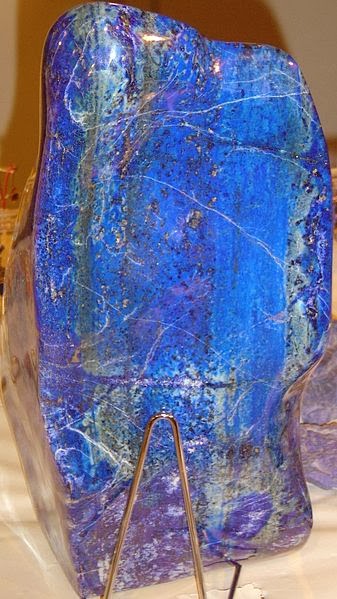
Polished Lapis Lazuli Block
King Tut's Mask
Lapis Lazuli, also known as just "Lapis", is a semi precious stone that has been prized for its beautiful deep blue color since antiquity.  It has beautiful flecks of gold pyrite within the blue stone.  It is a stone, not a mineral and not a crystal.  It has been mined in Afghanistan since 7,000 b.c. and was used as the eyebrows in King Tut's mask.  In ancient times, Lapis along with Turquoise were considered the most valuable stones.

At the end of the Middle Ages, Lapis was exported to Europe where it was ground and used as "ultramarine" -- the finest and most expensive blue pigment.  It was used by the most important artists of the Baroque and Renaissance periods. Vermeer's Girl With a Pearl Earring uses Ultramarine for her head scarf.
Vermeer's Girl with a Pearl Earring

Today, most Lapis is still mined in Afghanistan, but is also found in Chile, Canada, the United States and Russia.

The name "Lapis" comes from the Latin word for stone, and from the Arabic word for blue, "Azul".   It literally means "blue rock" and it is a rock, not a mineral.  It is composed of a variable mixture of the minerals lazurite, pyrite and calcite. The finest Lapis Lazuli is uniformly deep blue in color, opaque to semi-translucent and consists almost totally of lazurite.

I see pendants made of Lapis that have been carved into "points" or even "double terminated" points, like naturally occurring crystals, on etsy and elsewhere.  This is weird because Lapis is NOT a crystal at all, and is merely made of stone (rock!) and is carved in this shape for some reason.  Very odd.